Sila Bal, MD, MPH distributing reading glasses during a remote island outreach in Chuuk State.
Chuuk State
Our work in Chuuk State focuses on empowering local staff, strengthening systems, and improving access to care. In partnership with the Moran Eye Center and Chuuk State Hospital, Dr. Bal provides eye care and surgical services and built a comprehensive ophthalmic technician training program for Chuuk’s nursing and public health teams. These newly trained technicians enable effective screening, allowing Dr. Bal and local ophthalmologist Dr. Padwick Gallen to deliver sight-restoring and sight-preserving care. Her work has since expanded to the outer islands of Chuuk Lagoon, bringing care directly to the communities where patients live.
Dr. Albala partners with Chuuk State Hospital leadership, local government, and clinical teams to strengthen health systems and infrastructure. His formal assessment, based on the WHO Harmonized Health Facility Assessment, now guides departmental and system-wide budgeting and supply planning.
In 2024, ROSE was awarded a U.S. Department of the Interior Technical Assistance Program (TAP) grant and used it to build the Chuuk State Simulation Center from the ground up. ROSE turned an unused room at Chuuk State Hospital into a fully equipped simulation lab and designed a training program around the skills hospital staff needed most. ROSE has led four training sessions there so far, and local staff are now taking ownership of the space, running their own education and training.
ROOTS (Regional Outreach Opportunity in Training and Sustainability) for a Healthy Micronesia is a Rotary Foundation Global Grant sponsored by the Rotary Club of Pohnpei and Rotary District 5000, with ROSE Initiatives leading implementation. ROSE is extending its reach to Pohnpei, where we are building long-term collaboration with local clinicians, health leaders, and community partners.
Donated the hospital’s first video laryngoscope, along with AEDs, vital sign monitors, and Stop the Bleed kits, with hands-on training for hospital staff
Ran two community health fairs with College of Micronesia nursing students, screening over 200 residents for blood pressure, glucose, BMI, and vision, with referrals to local care
Delivered Stop the Bleed and BLS training at the Community Health Center and Seinwar elementary school
Provided AED and resuscitation training to the fire and rescue department
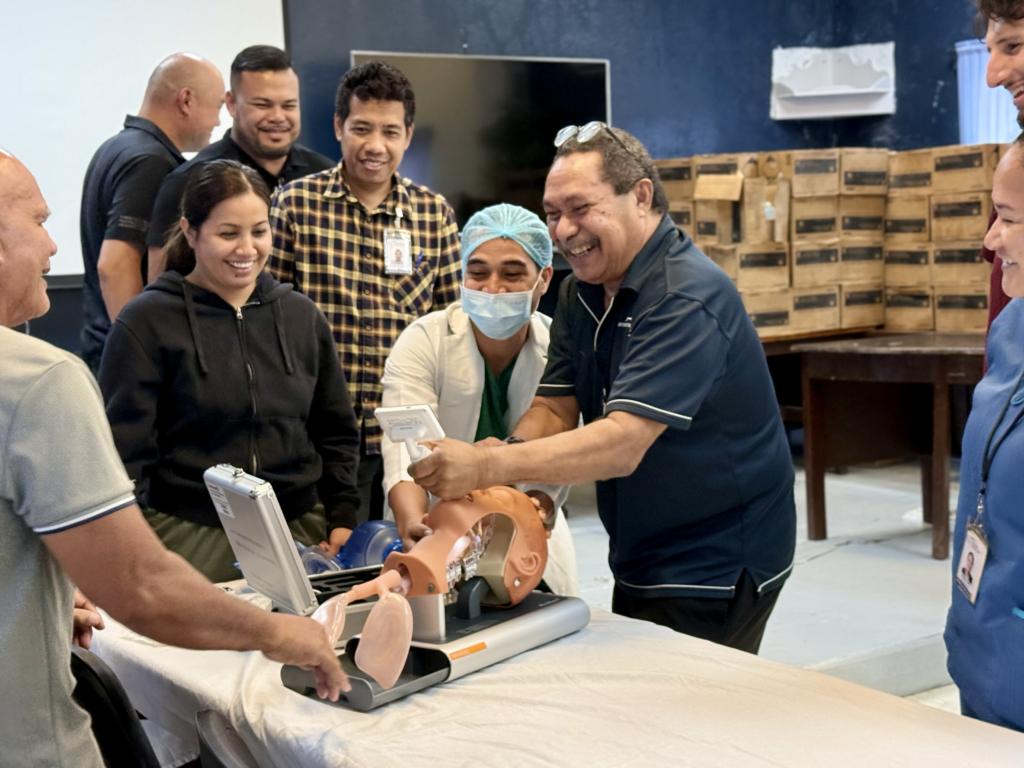
Clinicians at Pohnpei State Hospital train on the hospital’s first video laryngoscope, donated by ROSE Initiatives to make emergency airway care safer and more effective.
Opportunities on the Horizon
Across the Pacific, entire communities live beyond the reach of reliable infrastructure, not because they’re hard to serve, but because the system was never built with them in mind. ROSE is building a durable, locallyanchoredmodel that can move with the ocean, meet people where they are, and leave behind capacity, not dependency.
In the next chapter, we’re expanding marine-based remote outreach through chartered liveaboard missions. The point is continuity: returning, building trust, and strengthening local teams through consistent presence and practical resources.
At the same time, we’re investing in simulationtraining programs and Centers of Excellence, where clinicians can train for high-stakes scenarios, refine core skills, and build confidence while reducing burnout.