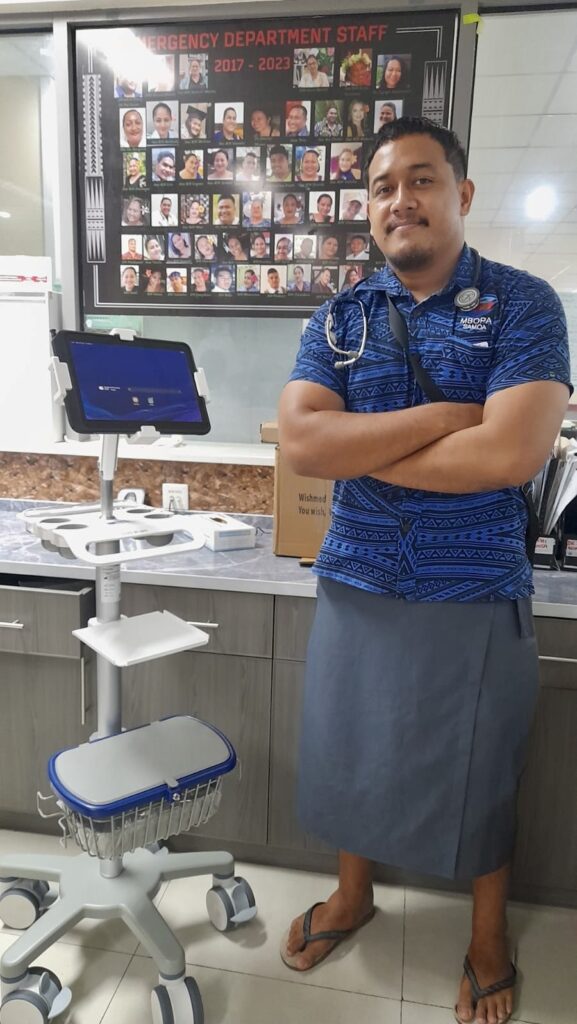
Unboxing the first ultrasound for the emergency department at TTM Hospital
Apia
Dr. Albala worked with emergency physicians and medical trainees at Tupua Tamasese Meaole (TTM) Hospital in a supervisory role, focusing on teaching emergency ultrasonography. Dr. Albala performed a needs assessment for the emergency department (ED). Due to significant difficulties in performing CT imaging for emergency patients, the local physicians were very interested in an alternative imaging modality.
Dr. Albala found that after a month training the emergency providers in various techniques of ultrasound, they endorsed improved diagnostic capability, medical decision-making, and felt greater autonomy and empowerment to consult specialists. This was most pronounced in intra-abdominal, gynecologic, traumatic, and cardiac emergencies.
Since the emergency physicians did not have access to an ultrasound, Dr. Albala secured an AUD $10,000 grant co-funded by Secretariat of the Pacific Community (SPC) and St. Vincent’s Pacific Health Fund. He applied those funds towards a Philip Lumify Ultrasound system for the TTM Hospital Emergency Department.
He is the founder and president of ROSE Initiatives, through which he leverages wilderness and emergency medicine training to build capacity and strengthen systems and infrastructure in remote and under-resourced places. Dr. Albala loves to explore the world through food, and he spends most of his free time in the water with his wife, Dr. Sila Bal.
ROSE Initiatives exists for one simple reason: geography should never decide who gets to learn, who gets help, and who gets left behind.
Across the Pacific, entire communities live beyond the reach of reliable infrastructure, not because they’re hard to serve, but because the system was never built with them in mind. ROSE is building a durable, locallyanchoredmodel that can move with the ocean, meet people where they are, and leave behind capacity, not dependency.
In the next chapter, we’re expanding marine-based remote outreach through chartered liveaboard missions. The point is continuity: returning, building trust, and strengthening local teams through consistent presence and practical resources.
At the same time, we’re investing in simulationtraining programs and Centers of Excellence, where clinicians can train for high-stakes scenarios, refine core skills, and build confidence before the real moment arrives.
Donors and volunteers aren’t supporting a single trip. You’re helping build an ecosystem that blends logistics, education, and partnership into something scalable. If you believe the strongest impact is the kind that keeps working long after you’ve left, ROSE is for you.